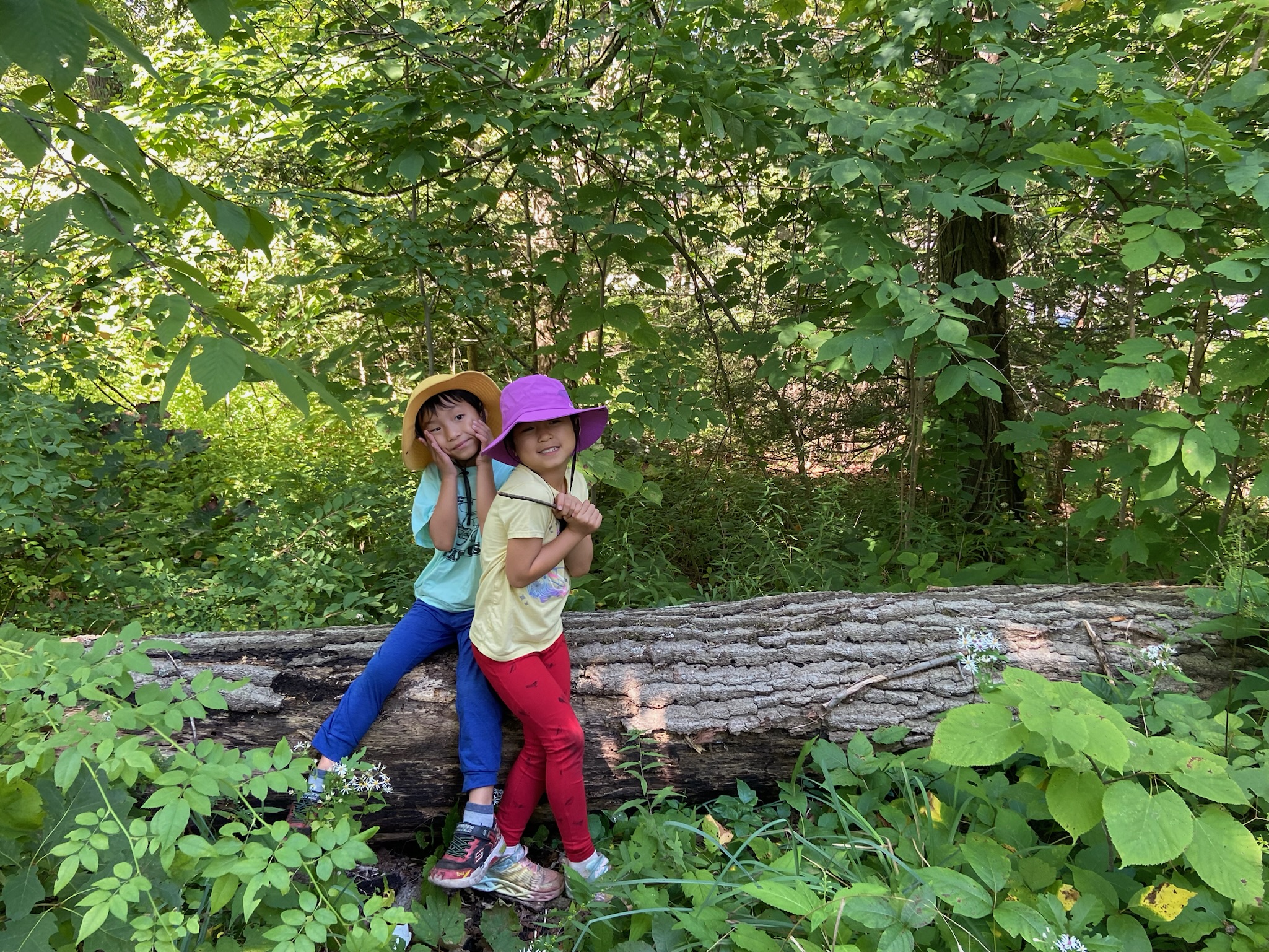
There’s been some discussion about dual-language schools in the group recently. From the questions and comments, I’ve noticed that there actually isn’t much information publicly shared about how U.S. dual-language programs really work. Because of that, some parents end up having misunderstandings or mixed impressions about these schools. So I wanted to share more here, hoping it helps everyone understand U.S. dual-language schools a bit better.
I’ve mentioned before that, for families like ours—where we already teach character recognition and practice reading at home—the Chinese curriculum in school tends to feel relatively easy. (For families who don’t speak Chinese at home and don’t teach it at all, their experience is completely different.) But now that both kids are in third grade, they’re finally learning characters they didn’t previously know, and recently I’ve started seeing them write Chinese compositions.
This time, they’re learning to write a narrative essay. From my daughter’s homework, it looks like the teacher began by introducing the key elements of a narrative: time, place, characters, cause, process, and outcome. The first task was to have students identify these elements in a sample paragraph and mark them with different symbols.

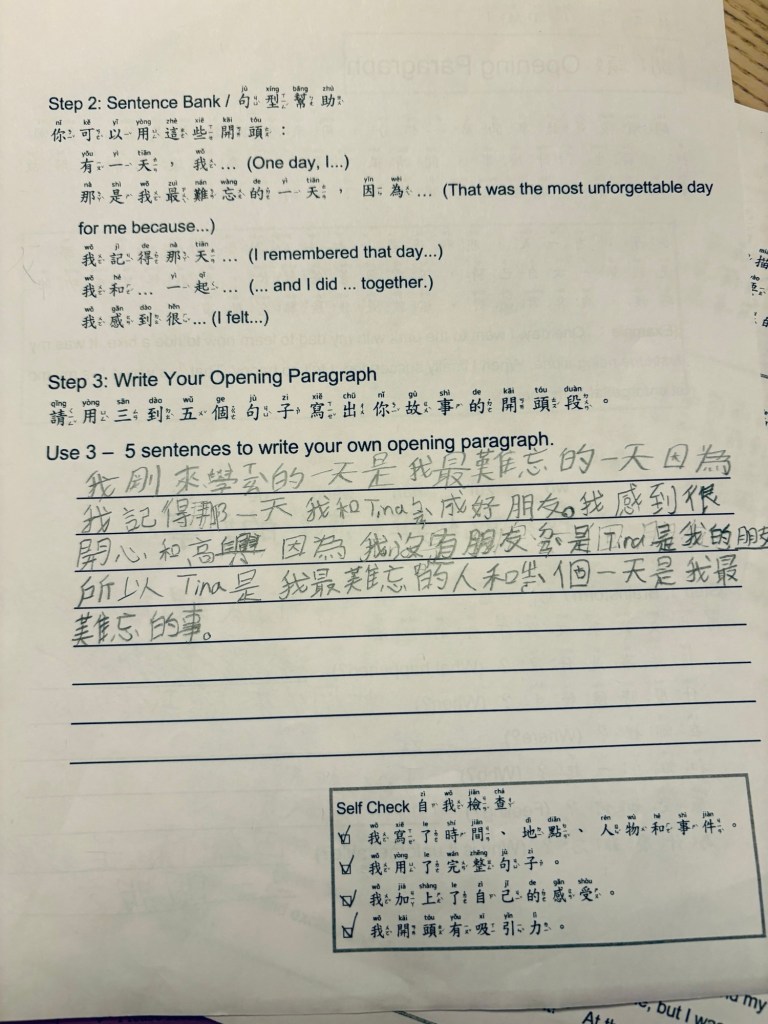

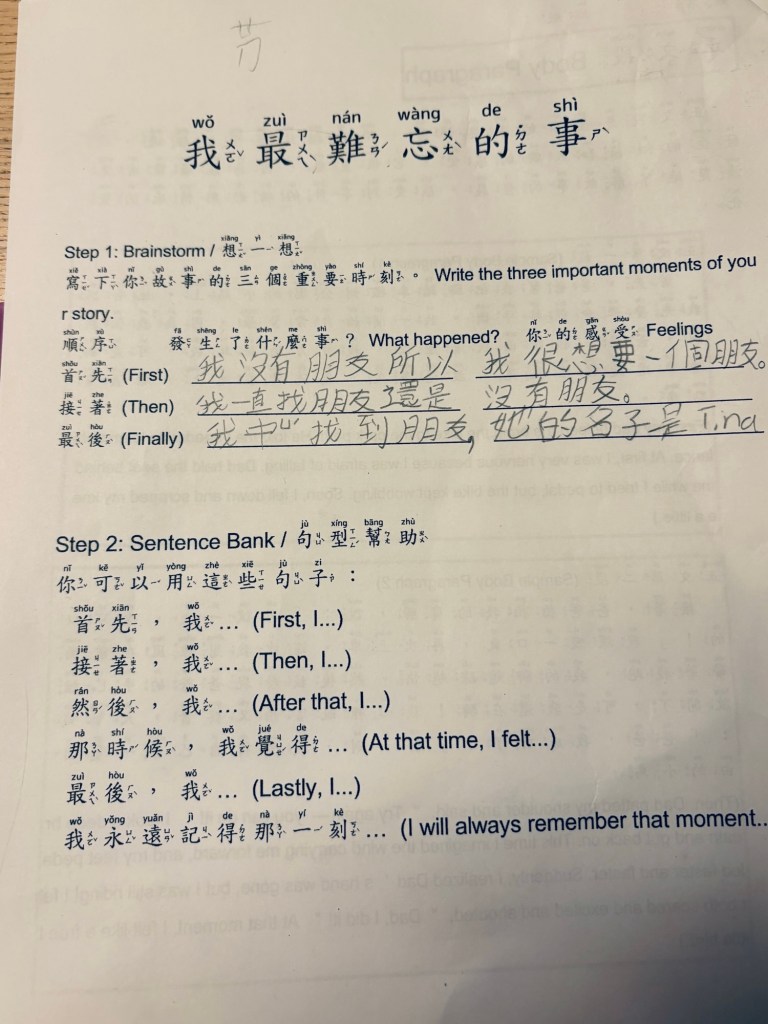

Next, the teacher taught them how to write an opening paragraph. She separated the narrative elements and had students fill in the blanks to combine them. She also provided useful sentence starters for openings, such as: “One day, I…”, or “That was the day I…, because…”
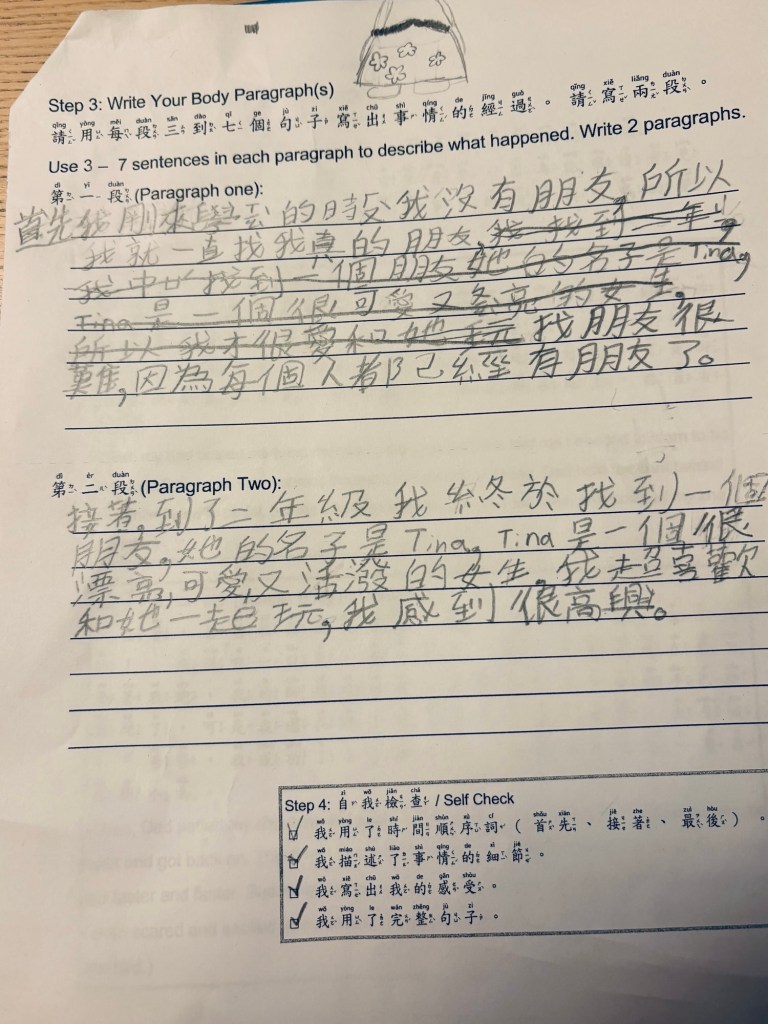
After writing the opening, the teacher gave a second worksheet to teach how to write the body. The body was divided into two paragraphs, guided by sentence patterns such as: “First…,” “Next…,” and “Finally…” Writing two separate paragraphs was a real challenge for my daughter—at first, she wrote both paragraphs almost exactly the same. Later, when the teacher provided a sample body paragraph, I asked her to read it aloud, then we discussed how the two paragraphs were different before she revised her own work.
Seeing all of this reminded me of how I learned English back in Taiwan. We used similar structures and sentence patterns to help us write paragraphs. Over the years, I’ve come to realize that the process of learning any language often looks similar: building vocabulary, developing a sense for the language, reading a lot. Whether you’re learning English in Taiwan or learning Chinese overseas, the steps are pretty much the same. What matters most is persistence—keep going, keep trying, and keep practicing.
 Bao & Bun's Bilingual Journey
Leave a comment