
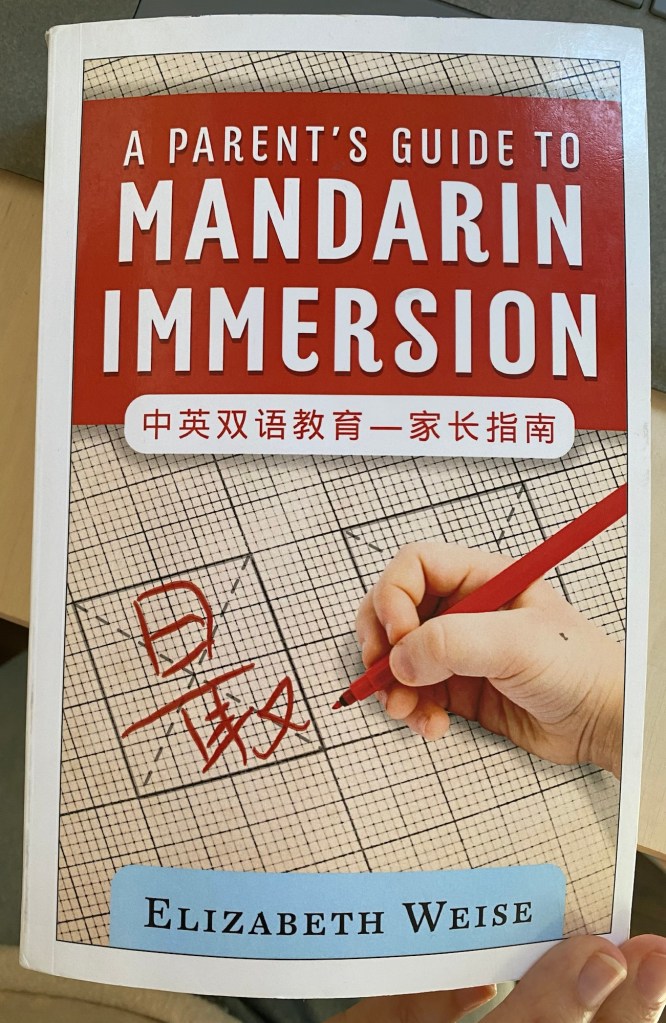
I had the opportunity to interview Elizabeth Weise for Our Chinese and English Podcast. In preparation for that episode, I read her book, A Parent’s Guide to Mandarin Immersion, and it was delightful to see so many simple explanations about Mandarin immersion schools and the expectations we should have as parents. This is also when I realized our school is not a true Mandarin immersion program because the amount of Chinese being taught doesn’t qualify it as an MI school.
Since the interview, I also spoke with two moms. One has two kids who went to a true 50/50 Mandarin immersion school. One of her kids thrived and achieved a high level of Chinese proficiency, while the other had no interest in learning Chinese and now knows very little compared to the sibling. When I asked why one kid was willing to learn and the other wasn’t, the mom couldn’t pinpoint a specific reason. It comes down to the fact that every kid is different, and sometimes you can’t force a child if they’re strongly against it.
The other mom I spoke to has three kids in our school. She was kind enough to share how the school has changed over the past few years, particularly how the Chinese curriculum has been diluted after an administrative change. She credits her children’s fluency to their nanny, who speaks no English, their extracurricular activities in Chinese, and speaking Chinese at home.
This is when I kind of found the solution to the bilingual puzzle: family education and a child’s desire to learn. Whether you’re in a Mandarin immersion program, weekend Chinese school, or homeschooling, ultimately it’s the parents who drive the process and make it successful. However, cultivating interest or providing a Chinese environment to kids seems very helpful, but for some kids who have a strong preference for English, there’s only so much parents can do.
 Bao & Bun's Bilingual Journey
Leave a comment